

Concrete driveway specifications vary based on intended vehicle loads and environmental conditions. Standard residential driveways require a minimum 4-inch thickness for vehicles under 6,000 pounds, while medium-duty applications need 6 inches of reinforced concrete for weights up to 14,000 pounds. Soil conditions, freeze-thaw cycles, and regional climate factors influence thickness requirements, with northern regions often requiring 6-inch minimums. Proper reinforcement methods and regular maintenance guarantee peak load-bearing capacity, revealing the complex interplay of factors that determine driveway durability.
Expert Highlights
- Residential driveways require minimum 4-inch thickness for standard vehicles, while commercial applications need 6-8 inches for heavier loads.
- Concrete strength should range from 2,500 PSI for residential to 4,000 PSI for commercial driveways to handle expected loads.
- Soil conditions directly influence required thickness, with clay soils needing additional reinforcement compared to well-draining sandy soils.
- Freeze-thaw regions demand 1-2 inches extra thickness and may require steel reinforcement for structural integrity.
- Vehicle weight classifications determine thickness needs: passenger vehicles (3,000-6,000 lbs) need less than heavy-duty vehicles (over 26,000 lbs).
Understanding Load Types and Vehicle Weight Classifications

When evaluating the load capacity of concrete driveways, understanding the different types of loads and vehicle weight classifications serves as an essential first step in proper design and construction.
Vehicle loads fall into distinct categories based on axle weight and frequency of use, ranging from light passenger vehicles to heavy commercial trucks.
Standard passenger vehicles, including cars and SUVs, typically exert loads between 3,000 and 6,000 pounds, while light trucks may range from 6,000 to 10,000 pounds.
Medium-duty vehicles, such as delivery trucks and small construction equipment, generate loads between 10,000 and 26,000 pounds, whereas heavy-duty vehicles exceed 26,000 pounds and require special consideration in driveway design.
Engineers must also account for both static loads, when vehicles are parked, and dynamic loads occurring during vehicle movement and maneuvering.
With proper installation and maintenance, a high-quality concrete driveway can withstand these various load types for up to 30 years.
Minimum Thickness Requirements for Residential Driveways

The standard thickness requirements for residential concrete driveways depend heavily on anticipated vehicle loads, soil conditions, and local climate factors, with most building codes specifying a minimum of 4 inches for light-duty applications.
Different thickness specifications correlate directly to load-bearing capacity, where 4-inch slabs typically support passenger vehicles up to 8,000 pounds, while 6-inch reinforced concrete can handle medium-duty trucks approaching 14,000 pounds.
In regions experiencing frequent freeze-thaw cycles or extreme temperature variations, contractors must increase the minimum thickness by 1-2 inches and incorporate additional steel reinforcement to prevent seasonal cracking and maintain structural integrity throughout the driveway’s service life.
Certified team members perform thorough site preparation and utilize high-quality materials to ensure driveways meet all thickness and load-bearing requirements.
Standard Thickness Guidelines Required
Standard residential concrete driveway thickness requirements vary across different jurisdictions, though most building codes mandate a minimum of 4 inches for light-duty residential applications, given proper site preparation and reinforcement.
For properties with heavier vehicle traffic or in regions with challenging soil conditions, local authorities often specify increased thickness requirements of 5 to 6 inches.
Commercial driveways and those designed for regular heavy vehicle use typically require 6 to 8 inches of concrete thickness.
The specified thickness must account for several critical factors, including soil bearing capacity, anticipated traffic loads, climate conditions, and drainage characteristics.
Engineers and contractors generally recommend exceeding minimum requirements by at least 1 inch to provide an additional safety margin and extended service life, particularly in areas subject to freeze-thaw cycles or poor soil conditions.
Load Ratings By Thickness
Concrete driveway load ratings correspond directly to thickness specifications, with residential applications requiring careful consideration of anticipated vehicle weights and frequency of use.
Standard residential driveways typically require a minimum thickness of 4 inches to support passenger vehicles up to 8,000 pounds, while heavy-duty applications demand 5 to 6 inches.
For driveways expecting regular commercial traffic or heavy recreational vehicles, 6-inch thickness provides load capacity up to 16,000 pounds with proper reinforcement.
Critical stress points, such as entrance areas and turning zones, often warrant increased thickness of up to 8 inches to prevent cracking and surface deterioration under repeated heavy loads.
Engineers recommend incorporating steel reinforcement mesh or fiber additives when increasing load capacity, particularly in driveways exceeding standard residential specifications of 4 inches.
Climate Impact On Depth
Climate variations across geographical regions greatly influence minimum thickness requirements for residential driveways, with frost depth serving as a critical determinant in northern locations. In areas experiencing deep frost penetration, concrete driveways require greater thickness to prevent heaving and cracking during freeze-thaw cycles.
Northern states typically mandate minimum thicknesses of 6 inches, while regions with moderate climates may allow 4-inch depths. Areas experiencing frequent freeze-thaw cycles often require additional reinforcement through steel mesh or fiber additives, along with proper drainage systems beneath the concrete.
Coastal regions face unique challenges from salt exposure and humidity, necessitating enhanced mixture designs and increased thickness specifications to guarantee longevity.
Local building codes reflect these regional variations, incorporating climate-specific requirements that account for temperature extremes, precipitation patterns, and soil conditions.
Soil Conditions and Their Impact on Load Bearing Capacity
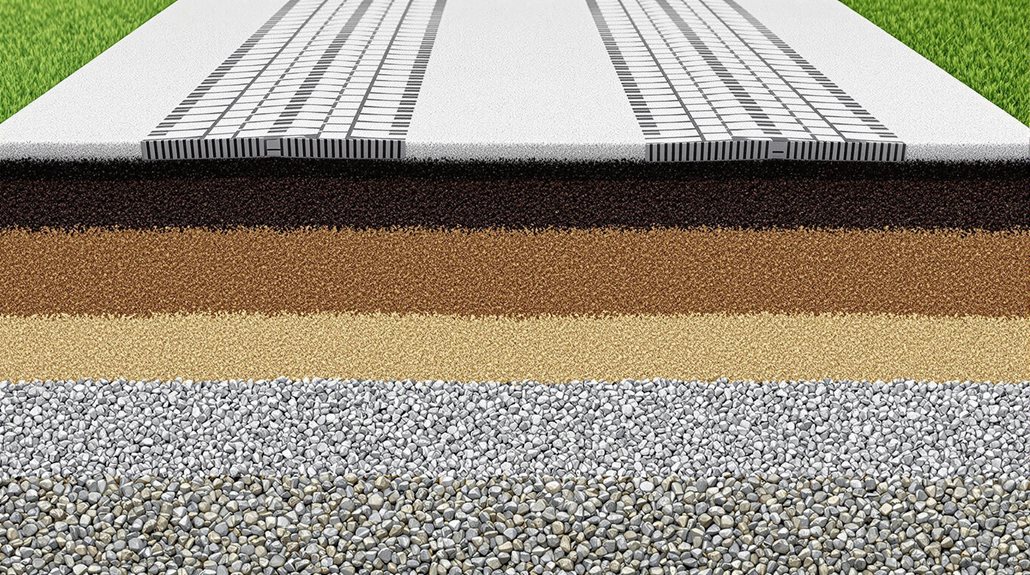
When evaluating a driveway’s load-bearing capacity, the underlying soil conditions play a fundamental role in determining long-term structural integrity and performance.
Different soil types exhibit varying levels of stability, with clay soils presenting particular challenges due to their expansive nature and moisture sensitivity.
Sandy soils typically provide excellent drainage but may require additional base preparation to prevent settling, while loamy soils offer a balanced mixture of stability and drainage characteristics.
Engineers classify soil bearing capacity in pounds per square foot (psf), with most residential driveways requiring soils capable of supporting 2,000-4,000 psf.
Professional soil testing can identify the presence of organic materials, moisture content, and compaction rates, which directly influence the required concrete thickness and reinforcement specifications.
Poor soil conditions often necessitate additional sub-base preparation or soil stabilization techniques to achieve ideal load-bearing performance.
Our certified team members conduct thorough soil assessments to ensure proper foundation preparation for every concrete driveway project.
Reinforcement Options to Increase Load Capacity
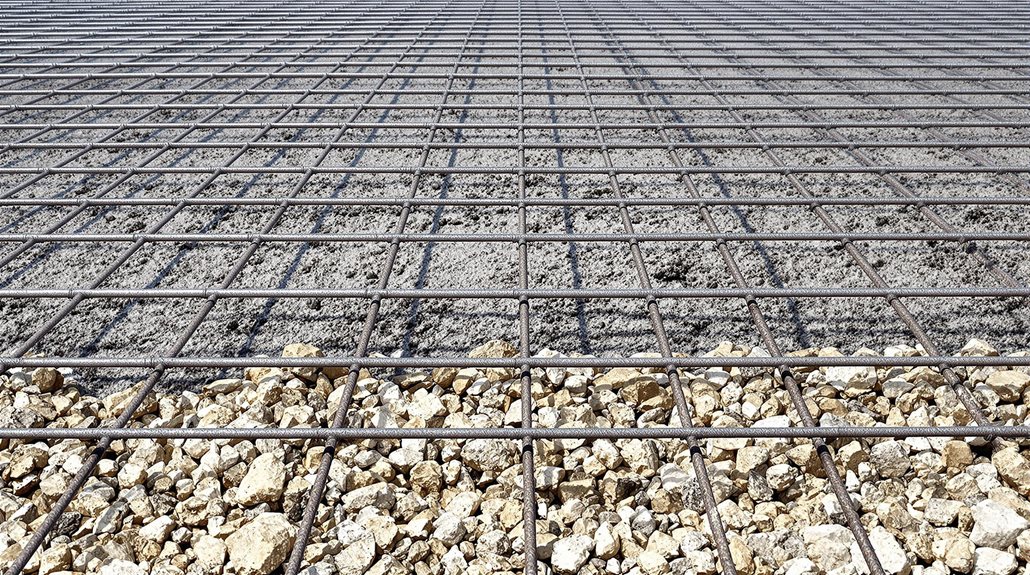
When considering ways to enhance a concrete driveway’s load-bearing capacity, two primary reinforcement methods stand out: traditional steel rebar placement and fiber mesh integration.
Steel rebar, typically placed in a grid pattern at specific depths within the concrete, provides excellent tensile strength and helps prevent major cracks from developing under heavy loads.
Fiber mesh reinforcement, consisting of synthetic or steel fibers mixed directly into the concrete, offers distributed strength throughout the entire slab while helping to control micro-cracking and reducing the likelihood of surface spalling.
Steel Rebar Placement Methods
Strategic placement of steel reinforcement bars within concrete driveways represents one of the most effective methods for enhancing load-bearing capacity and preventing structural failure.
Professional contractors typically install rebar in a grid pattern, spacing bars 12 to 18 inches apart in both directions, while maintaining proper concrete coverage of 2 to 3 inches from the surface.
The vertical positioning of rebar requires careful consideration, with ideal placement occurring in the lower third of the concrete slab where tensile forces are greatest.
Engineers recommend using chairs or supports to maintain proper elevation during the pour, ensuring bars remain at the designated height throughout installation.
For maximum effectiveness, bars should overlap by at least 40 times their diameter at joints, creating a continuous reinforcement network that distributes loads evenly across the entire driveway surface.
Fiber Mesh Applications
Beyond traditional steel reinforcement methods, fiber mesh technology offers contractors and homeowners an alternative approach to strengthening concrete driveways. These synthetic fibers, typically made from polypropylene, nylon, or glass materials, distribute throughout the concrete mixture during mixing to create a three-dimensional reinforcement network.
Common applications for fiber mesh in concrete driveways include:
- Secondary reinforcement to control plastic shrinkage cracking
- Enhanced impact resistance and surface durability
- Improved flexural strength and load-bearing capacity
- Reduced likelihood of edge spalling and corner breaks
The integration of fiber mesh reinforcement provides numerous advantages over conventional methods, particularly in residential applications where crack control is essential.
When properly mixed and placed, fiber-reinforced concrete demonstrates superior performance characteristics, including increased tensile strength and enhanced post-crack performance, making it an excellent choice for driveways subject to regular vehicle traffic.
Commercial Vs Residential Driveway Specifications
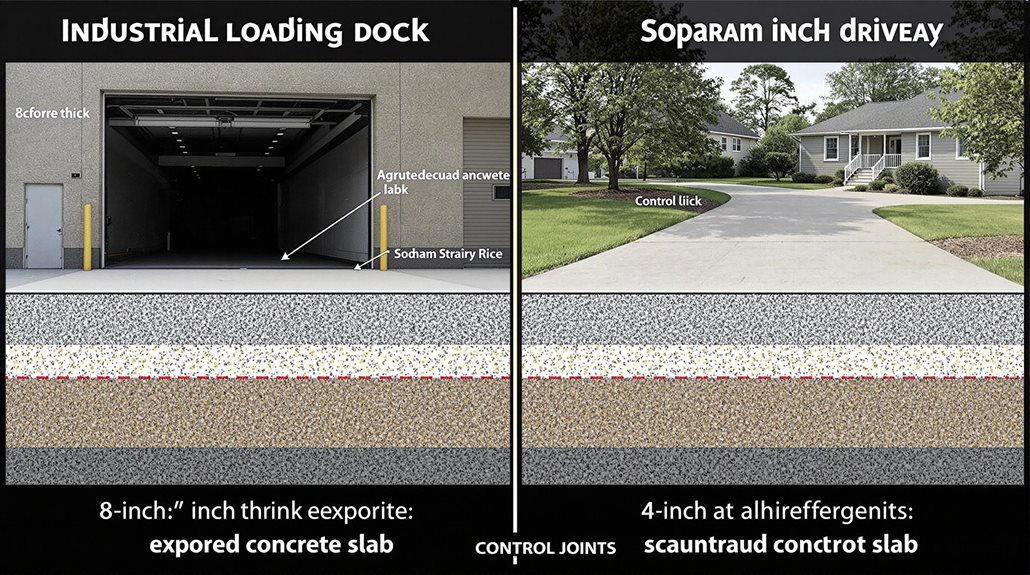
Commercial and residential driveways diverge considerably in their structural specifications due to fundamental differences in expected vehicle loads and traffic frequency. While residential driveways typically accommodate passenger vehicles and occasional delivery trucks, commercial driveways must withstand constant heavy traffic from delivery vehicles, waste management trucks, and commercial equipment.
| Specification | Commercial | Residential |
|---|---|---|
| Thickness | 6-8 inches | 4-6 inches |
| PSI Rating | 4000-5000 | 3000-4000 |
| Joint Spacing | 10-12 feet | 8-10 feet |
| Base Layer | 6-8 inches | 4-6 inches |
Industry standards require commercial driveways to maintain higher compressive strength ratings and increased thickness specifications, ensuring long-term durability under sustained heavy loads. Additionally, commercial installations necessitate more frequent control joints and superior base preparation to prevent premature failure and minimize maintenance requirements.
Calculating PSI and Load Distribution
Proper calculation of PSI (pounds per square inch) and load distribution patterns forms the foundation of driveway engineering specifications. Engineers analyze both static and dynamic loads, factoring in vehicle weights, frequency of use, and environmental stresses to determine ideal concrete specifications.
Load distribution calculations must account for:
- Maximum anticipated vehicle weight, including heavy equipment or delivery trucks
- Point load concentration from vehicle tires and stabilizing jacks
- Soil bearing capacity and subgrade composition
- Stress distribution angles through concrete thickness
The resulting PSI requirements typically range from 2,500 PSI for residential driveways to 4,000 PSI for commercial applications, with proper reinforcement essential for load distribution.
Modern calculation methods incorporate sophisticated software modeling, allowing engineers to visualize stress patterns and refine thickness specifications for maximum durability and cost-effectiveness.
Weather Factors Affecting Load Bearing Performance
While concrete driveways are engineered to withstand specific load capacities, their performance can be notably altered by seasonal weather patterns and environmental conditions that impact structural integrity.
Freeze-thaw cycles, in particular, can reduce a driveway’s load-bearing capacity by up to 30% through internal micro-cracking and subsequent water infiltration.
Extreme temperature fluctuations cause thermal expansion and contraction, which may lead to surface scaling and decreased compressive strength.
During periods of sustained heat above 90°F (32°C), concrete can experience reduced tensile strength, while prolonged exposure to temperatures below freezing can result in frost heave damage.
Additionally, moisture content greatly affects load distribution capabilities, with saturated concrete showing diminished performance compared to ideal moisture levels of 3-5% by volume.
Design Considerations for Heavy Equipment Access
Designing concrete driveways for heavy equipment access requires careful consideration of anticipated load weights, frequency of use, and specific vehicle specifications, including axle configurations and tire contact patterns.
Engineering calculations must account for both static and dynamic loads to guarantee long-term structural integrity.
Key design factors that professionals must evaluate include:
- Minimum concrete thickness of 6 inches for occasional heavy equipment, increasing to 8-12 inches for frequent use
- Reinforcement requirements, typically utilizing #4 rebar in a 12-inch grid pattern
- Properly prepared subgrade with 4-6 inches of compacted gravel base
- Strategic placement of control joints at 10-foot intervals to manage crack formation
The integration of proper drainage slopes, typically 1/8 inch per foot, helps prevent water accumulation that could compromise the driveway’s load-bearing capacity during equipment operation.
Testing Methods for Load Capacity Assessment
Testing methods for concrete driveway load capacity typically involve two primary approaches: core sample analysis and field load rating tests.
Core samples, extracted using specialized drilling equipment, undergo laboratory compression testing to determine concrete strength, density, and internal composition characteristics.
Field load rating assessments employ calibrated weight-bearing equipment to measure the driveway’s actual performance under controlled stress conditions, often utilizing specialized trucks or hydraulic load frames positioned at critical points along the surface.
Core Sample Analysis Methods
Core sample analysis represents one of the most reliable methods for evaluating concrete driveway load capacity, providing direct measurements of the material’s structural properties and composition. Through cylindrical extraction and laboratory testing, core samples reveal critical data about the concrete’s internal structure and strength characteristics.
The analysis process includes several key evaluation points:
- Compressive strength testing using calibrated hydraulic press equipment
- Aggregate distribution assessment through microscopic examination
- Air void content measurement via specialized imaging techniques
- Chemical composition analysis to determine cement-to-aggregate ratios
These extracted samples, typically 4 inches in diameter and spanning the full depth of the concrete, enable engineers to precisely determine the driveway’s actual load-bearing capacity.
The results inform decisions about required repairs, potential reinforcement needs, and future load limitations, ensuring ideal driveway performance and longevity.
Load Rating Field Tests
While core sampling provides detailed material analysis, field-based load testing offers engineers practical, real-world data about a concrete driveway’s performance under actual use conditions.
Common field tests include plate load testing, where hydraulic pressure is applied through circular steel plates to measure deflection and load-bearing capacity.
Engineers frequently employ non-destructive testing methods such as falling weight deflectometers (FWD), which simulate vehicle loads by dropping calibrated weights onto the surface while sensors measure the concrete’s response. The collected data, measured in kilonewtons (kN), helps determine the driveway’s structural capacity and identify potential weak points.
Static load testing, utilizing fully-loaded vehicles positioned at critical points, provides additional verification of load-bearing capabilities, particularly at edges and joints where stress concentrations typically occur.
Maintenance Practices to Preserve Load Bearing Strength
Preserving the load-bearing capacity of concrete driveways requires consistent, proactive maintenance practices that protect both surface integrity and underlying structural strength.
Regular maintenance of concrete driveways through proactive care is essential for protecting their structural integrity and long-term load-bearing capabilities.
Property owners must implement routine inspections and timely repairs to prevent deterioration of the concrete’s structural capabilities.
Key maintenance practices that help maintain ideal load capacity include:
- Application of penetrating sealers every 2-3 years to prevent water infiltration and subsequent freeze-thaw damage
- Prompt repair of surface cracks using appropriate epoxy or polyurethane fillers before they expand and compromise structural integrity
- Regular cleaning to remove corrosive substances, including deicing chemicals and automotive fluids that can degrade concrete
- Monitoring and maintenance of proper drainage patterns to prevent water pooling and subgrade erosion
These preventive measures, when consistently applied, help guarantee the driveway maintains its designed load-bearing strength throughout its service life.
Frequently Asked Questions
Can My Concrete Driveway Handle a Swimming Pool Installation Truck?
Most residential driveways can support pool installation trucks, but owners should verify their driveway’s thickness and reinforcement. A professional assessment is recommended to prevent potential damage or cracking.
How Soon Can I Park My Car After a New Driveway Installation?
Most homeowners can park passenger vehicles on their new concrete driveway after 7 days, but waiting the full 28 days guarantees maximum strength and durability for long-term surface protection.
What Happens if Oil Leaks Stain My Concrete Driveway?
Oil stains can permanently discolor concrete and seep deep into its porous surface. Professionals recommend cleaning spills immediately with cat litter, degreaser, or specialized concrete cleaners to minimize damage.
Do Tree Roots Affect the Load-Bearing Capacity of My Concrete Driveway?
Growing tree roots can greatly undermine a driveway’s structural integrity by creating voids beneath the surface and causing uneven support, which reduces its ability to handle heavy loads safely.
How Much Does Crack Repair Impact the Driveway’s Original Load Capacity?
Professional crack repairs can restore up to 75% of a driveway’s original load capacity, but structural integrity depends on repair quality, crack severity, and proper bonding techniques.
Expert Final Thougts
Proper design and construction of concrete driveways requires careful consideration of multiple factors, including load requirements, soil conditions, and environmental impacts. By adhering to recommended thickness specifications, incorporating appropriate reinforcement methods, and implementing regular maintenance practices, driveways can maintain their structural integrity and load-bearing capacity for decades. Understanding these technical aspects enables property owners and contractors to make informed decisions that balance cost, durability, and performance requirements for both residential and commercial applications.